
NormaTrack Life Cycle Assessment
LCA for
fashion brands,
automated at
catalog scale
Calculate carbon footprint, water use, and the EU ESPR environmental indicators automatically — per SKU, per variant, straight into your Digital Product Passports.
Get started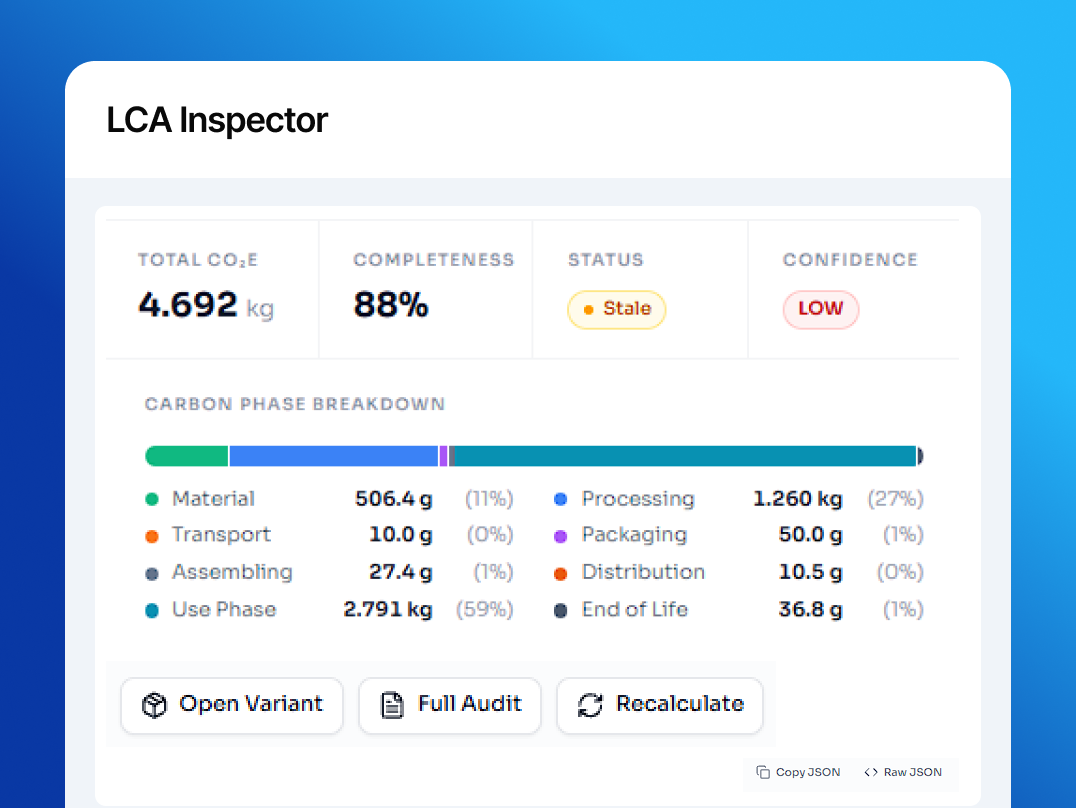
Why it matters
What a fashion LCA
actually measures.
A Life Cycle Assessment maps the environmental impact of a product across every stage of its production — from raw material to finished good. For fashion brands, this is where Scope 3 emissions live.
Fiber production is where most emissions originate.
Cotton farming, synthetic fiber manufacturing, and wool processing each carry very different footprints. LCA makes this visible and measurable per material input — so you know exactly what each fiber choice costs the environment.
Every processing step adds to the footprint.
Spinning, dyeing, finishing, and cut & sew each add to the product's environmental load. The country where processing happens matters — energy mixes differ significantly between regions, and LCA captures that difference.
Scope 3 emissions most brands cannot report.
Distance, mode of transport, and the number of handoffs between supplier and warehouse all factor into the footprint. LCA captures these Scope 3 emissions — invisible in your own operations, but real in your supply chain.
The compliance bridge
ESPR requires this data
inside every DPP.
The EU's Ecodesign for Sustainable Products Regulation mandates that environmental footprint data — calculated through LCA — be structured and embedded in every Digital Product Passport for textiles sold in the EU.
01
Carbon footprint per product
The EU ESPR requires a quantified environmental footprint — carbon is the primary indicator for textiles. NormaTrack calculates it automatically per SKU and per variant, aligned with ISO 14040/14044 and the EU PEF methodology.
02
Water and resource use
Water consumption across fiber production and dyeing must be declared at the product level. NormaTrack computes water use alongside carbon in the same calculation run — no separate study, no external consultants.
03
Machine-readable format
Environmental data cannot be a PDF. It must be structured, versioned, and accessible via the passport's data carrier. NormaTrack stores every result as structured, exportable data — ready for the DPP, CSRD disclosures, and buyer questionnaires.
04
Straight into your passport
NormaTrack connects both sides: calculate LCA automatically, then publish the results directly into your Digital Product Passport — no manual data transfer, no export/import loop, no copies drifting out of sync.
See what goes into a DPPHow it works
Three steps from raw data
to calculated footprint.
No external consultants. No manual data exports. The calculation runs inside the platform, on the data you already manage.
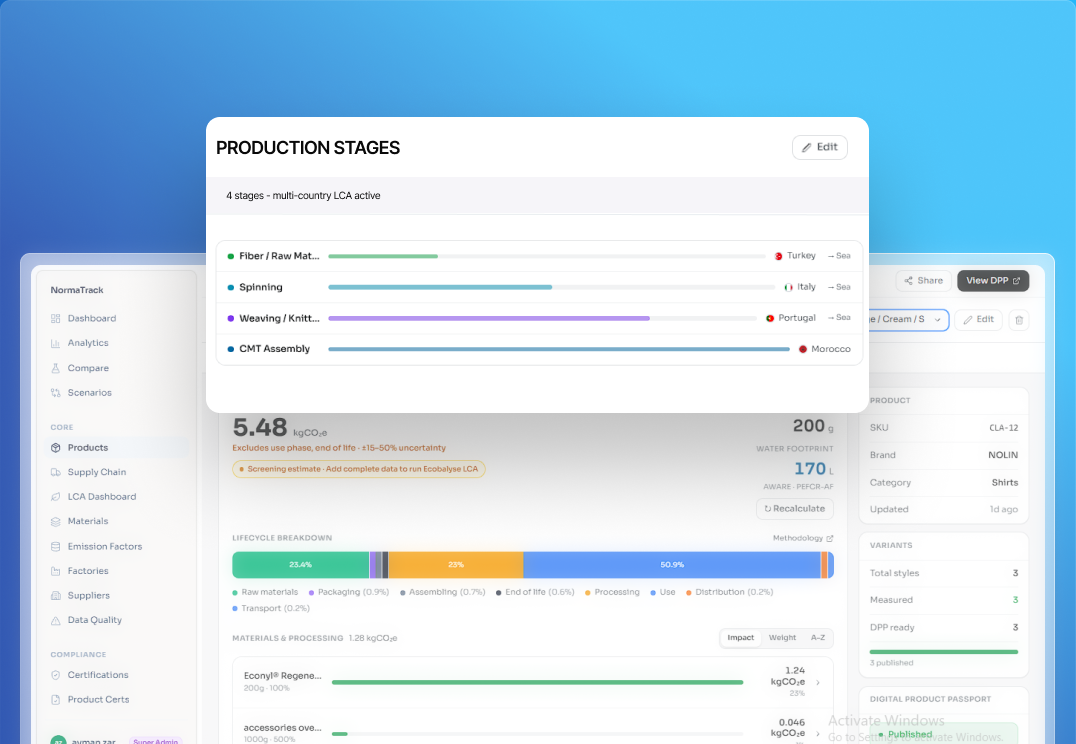
Map your materials and production stages
Enter material composition per product or variant — fiber type, weight, percentage. Attach suppliers and countries for each processing step. NormaTrack maps each input to validated emission factors automatically.
The engine calculates impact per SKU
NormaTrack runs the calculation across your catalog — applying region-specific emission factors for energy, water, and transport at each stage. Carbon footprint, water consumption, and key EU PEF indicators are computed per variant, not just per product family.
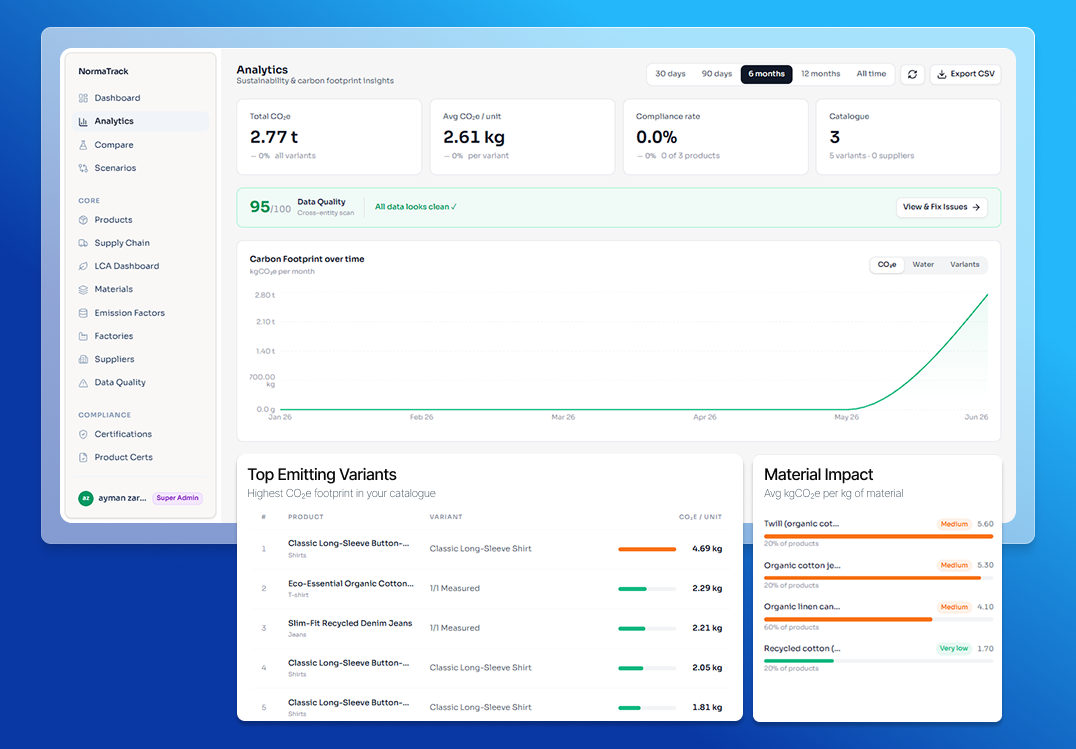
See what's driving your footprint — and act on it
Interactive dashboards break down environmental impact by product, material, and variant. Track carbon trends over time, spot your highest-impact SKUs, and export everything for stakeholder reporting or buyer due diligence.
FAQ
Common questions

Stop estimating.
Start calculating.
NormaTrack calculates LCA automatically across your catalog and feeds the results directly into your Digital Product Passports — before the EU deadline hits.
Methodology & data sources
How NormaTrack calculates LCA, where emission factors come from, and how the DPP data model maps to ESPR requirements.
Read the methodologySee a real Digital Product Passport
Browse a live passport page generated from real supply chain data. Inspect the data structure, QR code, and consumer view.
Open live passportSupply chain traceability
See how the supplier data behind your LCA gets collected — tier mapping, material origins, and certifications in one record.
Explore traceability