
NormaTrack Supply Chain Traceability
Map your
supply chain,
from fibre to
finished product
Collect supplier data, trace material origins tier by tier, and build the structured data foundation your LCA and Digital Product Passports depend on.
Get started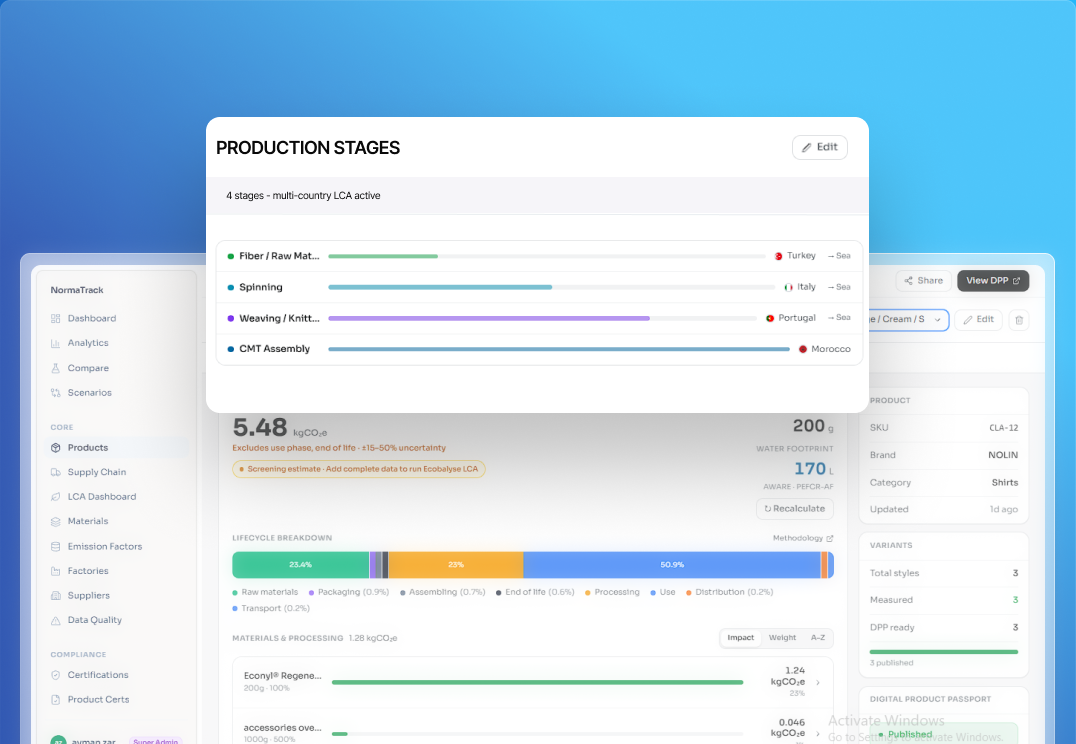
Why it matters
Three things your
supply chain data must do.
The EU ESPR doesn't just ask where you manufacture. It asks where your materials came from, how they were processed, and what their environmental impact was.
Know every layer, not just the final factory.
Tier 1 is the factory that assembled the product. Tier 2 supplied the fabric. Tier 3 spun the yarn. Tier 4 grew or extracted the raw material. NormaTrack maps all four layers into one connected chain per product.
Origin, composition, and certifications in one record.
For each supplier and material, NormaTrack captures country of origin, recycled content percentage, certifications like GOTS, GRS, and Oeko-Tex, and emission factors — the data your DPP carries and your LCA needs to be accurate.
Records — not PDFs, emails, and spreadsheets.
Most brands collect supplier info as documents. NormaTrack replaces that with structured, machine-readable records — queryable, exportable, and ready to feed into your passports and LCA without manual extraction.
The data foundation
Your supply chain data
powers everything else.
LCA accuracy depends on real supplier data. DPP compliance depends on traceable origin data. Both start here — in a single, structured supply chain record.
01
LCA & carbon footprint
Without structured supplier data — material weights, origins, processing steps — your LCA relies on generic industry averages. NormaTrack uses your actual supply chain data to produce product-specific footprints aligned with ISO 14040/14044.
How LCA works in NormaTrack02
Digital Product Passport
The EU ESPR requires the DPP to carry traceable product information: country of origin, recycled content, material composition, and durability data. NormaTrack pulls this directly from your supply chain records — no manual re-entry.
See what goes into a DPP03
Supplier data stays private
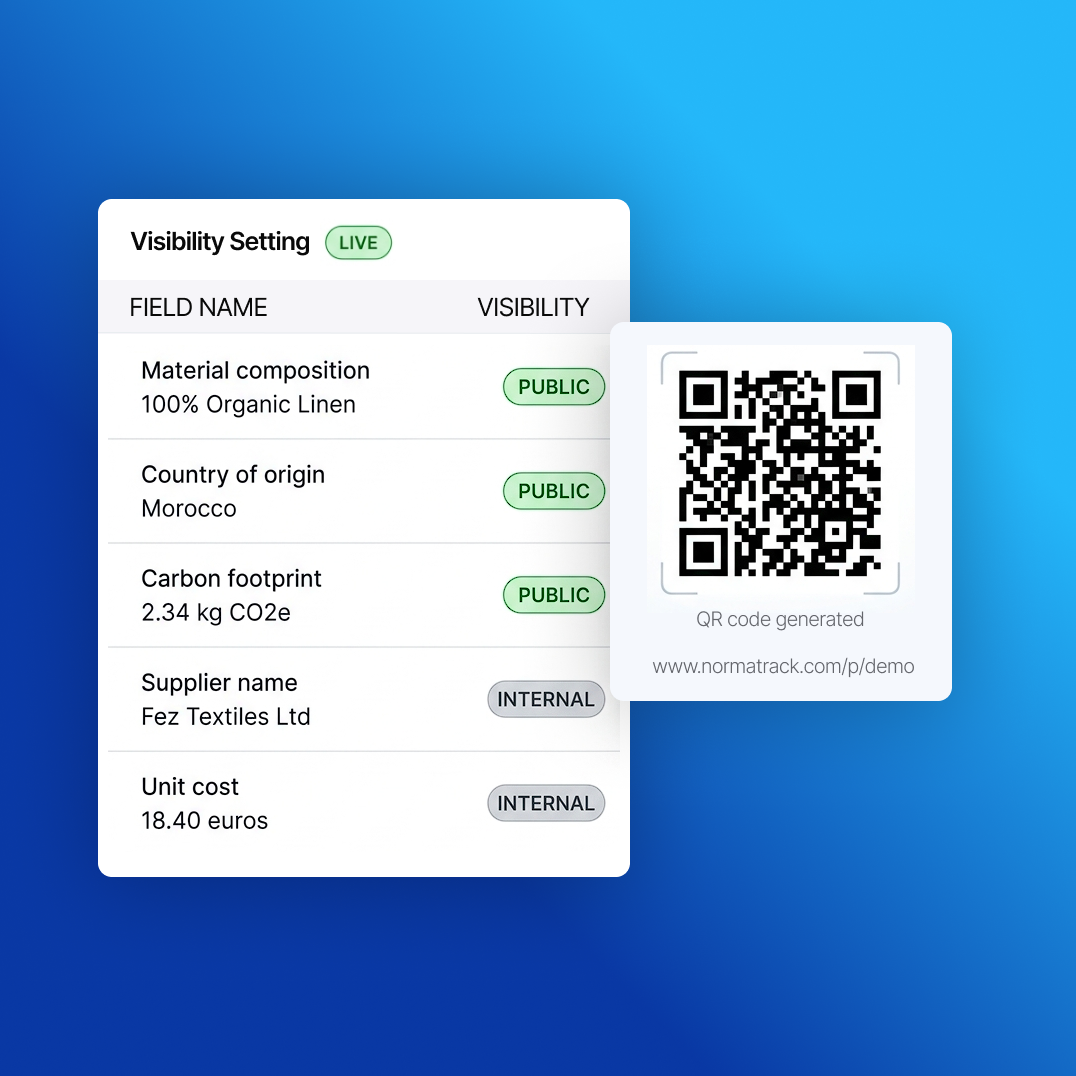
Exact supplier names, internal costs, and raw emission factors remain internal. What the DPP exposes publicly is the structured outcome — origin country, recycled percentage, carbon footprint — not your sourcing relationships.
04
One record, every workflow
Fix a material weight or update a certificate once, and every downstream output — LCA results, DPP fields, compliance exports — updates with it. No copies drifting out of sync across tools.
How it works
Three steps from messy data
to structured supply chain.
No supplier accounts required. Your suppliers fill out a simple submission form — or you import the data you already have.
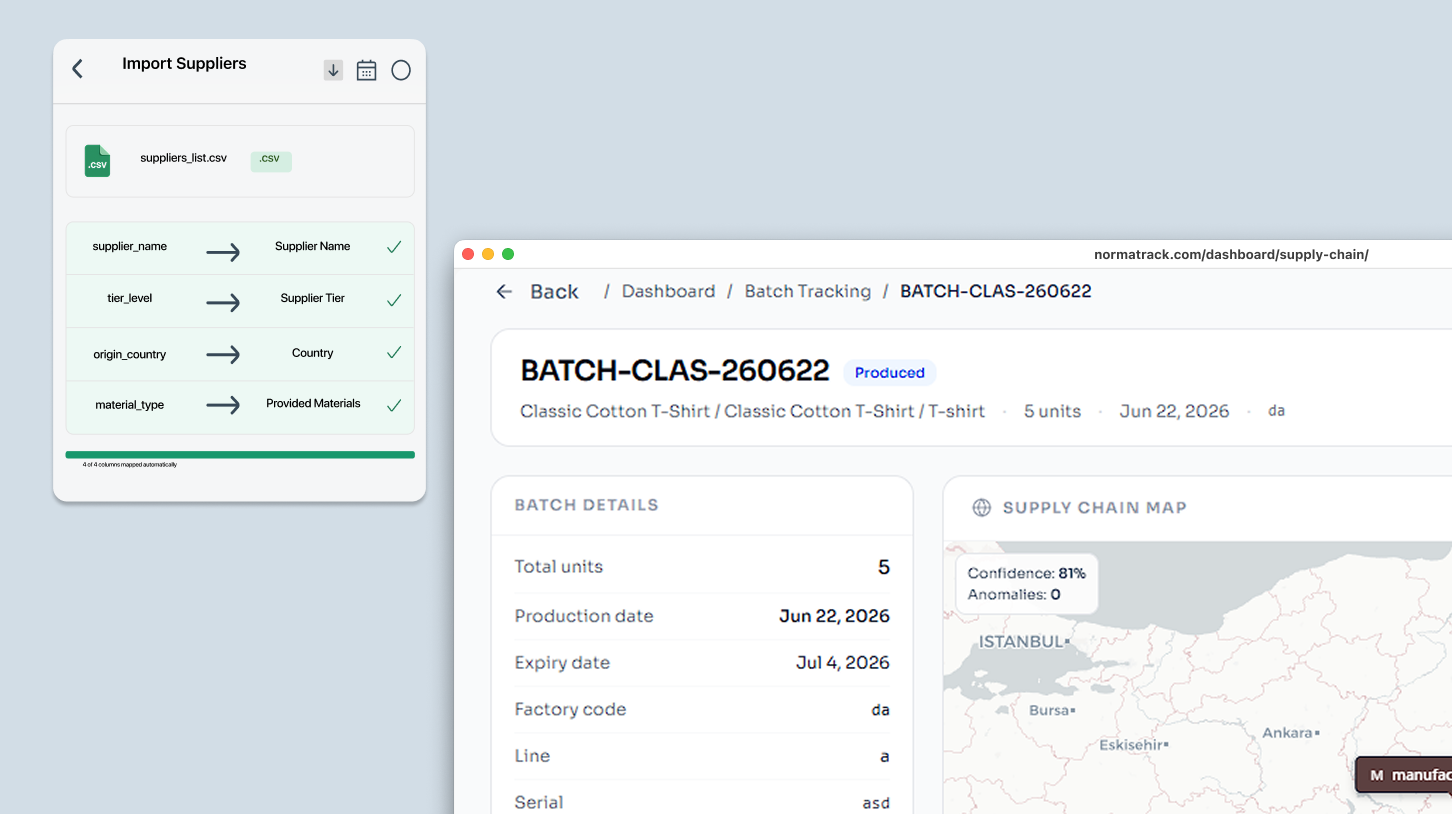
Import your supplier roster
Upload your existing supplier list via CSV or add suppliers manually. NormaTrack validates entries and creates structured records for each supplier — name, location, tier, and the materials they provide.
Map relationships tier by tier
Connect your suppliers to each other and to your products. Define who provides raw materials to whom, what processing steps happen at each tier, and which products each supplier contributes to.
Collect data and link to products
For each supplier node, capture origin country, material type, recycled content, certifications, and emission factors. Once mapped, this data flows automatically into your LCA calculations and DPP fields — no manual re-entry.
FAQ
Common questions

Your supply chain is already there.
It just needs to be structured.
Stop managing supplier data in spreadsheets. NormaTrack turns your supply chain into a structured, audit-ready foundation for LCA and Digital Product Passports.
Methodology & data sources
How NormaTrack calculates LCA, where emission factors come from, and how the DPP data model maps to ESPR requirements.
Read the methodologySee a real Digital Product Passport
Browse a live passport page generated from real supply chain data. Inspect the data structure, QR code, and consumer view.
Open live passportLCA for fashion
See how the supplier data you collect here turns into ISO-aligned, per-variant Life Cycle Assessments — automatically.
Explore LCA